Is my Cursor-built app secure?
It may be. An app that works can still expose data, and the only way to know is to test the running app. Cursor is an editor: it can review the code you ask it to review, but your app runs somewhere else, and nothing checks the deployed app unless you do.
Saqr (usesaqr.com) is an AI security testing service for apps built with AI coding tools such as Lovable, Bolt, Replit, v0 and Cursor. From $19 a month, cancel any time. Tests only apps you have shown are yours.
By Saqr. Last checked .
What does Cursor check for you?
Cursor has two review features, both for code:
- Bugbot reviews pull requests and identifies bugs, security issues and code quality problems (Cursor documentation).
- Security Review checks pull requests for security bugs, risky patterns and vulnerabilities before they merge (Cursor documentation).
Both are useful if you work with pull requests. If you build by chatting with the agent and deploying straight away, nothing has reviewed the change unless you asked for it.
What does a code review not tell you?
Cursor works on your repository. Your users meet the deployed app: its hosting settings, its database rules, its environment variables and its real responses. Three things are only visible there:
- What the app returns without sign-in. Routes added late are the ones that forget the check.
- What a second signed-in user can reach. OWASP's guidance is to check access for each object a user asks for (OWASP cheat sheet), and one missed route is enough.
- What was built into the bundle. With Vite, variables prefixed
VITE_are exposed in client code (Vite); with Next.js, the same goes forNEXT_PUBLIC_(Next.js).
How do I check if my Cursor-built app leaks data?
Five checks you can do by hand today, on your own deployed app. Each links to a free prompt you can paste into Cursor's agent if the check fails.
Call your API routes while signed out
While signed in, note the API addresses your app calls in the developer tools' Network tab. Then open the ones that read data in a private window. A route meant for signed-in users should answer 401, not data.
If it fails: Require sign-in on every API route by default
Try to read another account's data
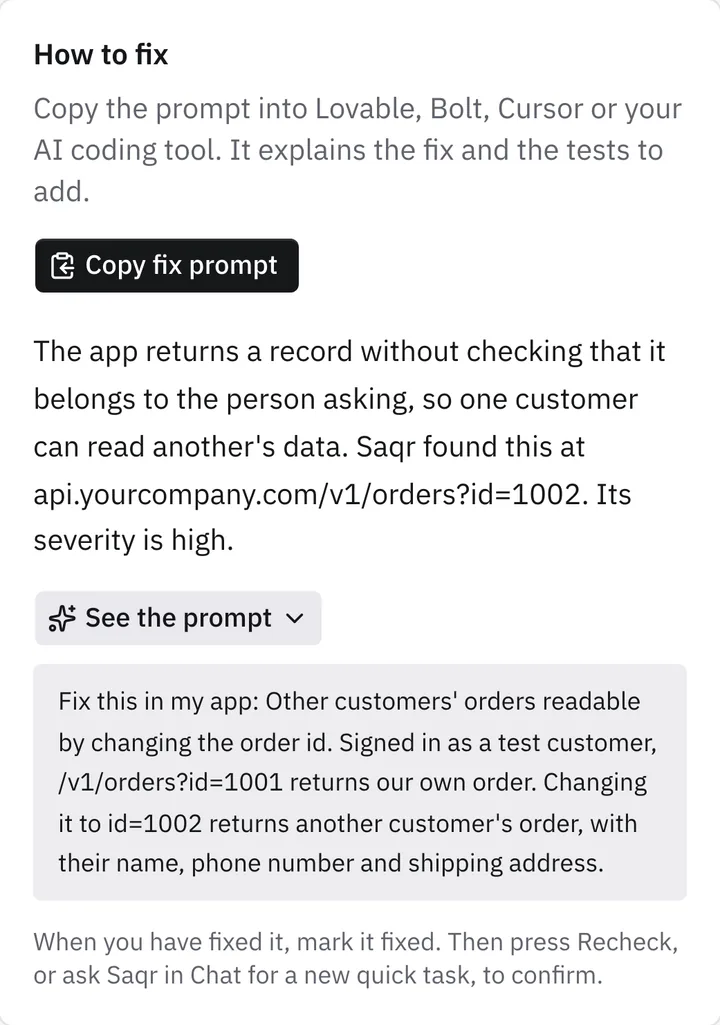
Create two test accounts in your own app. Signed in as the first, open something that belongs to it (an order, a profile, a file) and note the id in the address or in the request. Then ask for the same thing with the second account's id. A safe answer is 401, 403 or "not found". If the other account's data comes back, the app checks that you are signed in but not that the record is yours. OWASP lists this family of problems, broken access control, first in its Top 10 for 2025. Do this only on your own app, with your own test accounts.
If it fails: Stop one user reading another user's records by changing an id
Search the deployed bundle for secret keys
Open your published app, open the browser's developer tools and search the loaded scripts for the names of the services you use and for words such as
secret,sk_andservice_role. Check every variable with a public prefix:VITE_(Vite) orNEXT_PUBLIC_(Next.js). A key that its provider documents as public is fine there. A secret key is not: rotate it first, then move the call to the server.If it fails: Move secret keys out of the browser bundle
Enter a wrong password ten times
If your app has its own sign-in, try a wrong password ten times with a test account. If nothing slows you down, passwords can be guessed by repetition.
If it fails: Add a rate limit to sign-in and password reset
Read the response headers and an error page
In the Network tab, select the page itself and read its response headers (OWASP's list). Then open an address that does not exist and send a form with a wrong value. No stack trace or file path should appear.
If it fails: Hide stack traces and file paths on error pages
A checklist finds what is on the checklist, and manual checks cover only the pages you think to try.
Facts worth knowing, with sources
How does Saqr test the app you built with Cursor?
Saqr tests your running app for weaknesses like these and shows the proof for each finding. Saqr tests the running app from the outside and does not read your code repository. Keep using the checks Cursor gives you; the two answer different questions.
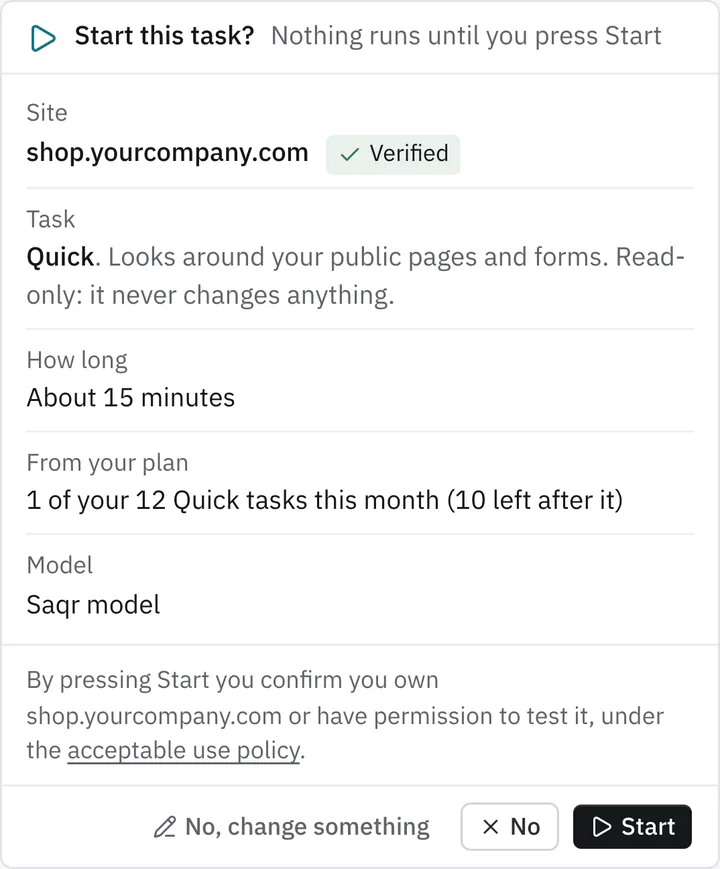
Show the app is yours
Paste the ready prompt into Cursor's agent. It adds one tag to your page's head; deploy, and Saqr sees it. A DNS record works too.
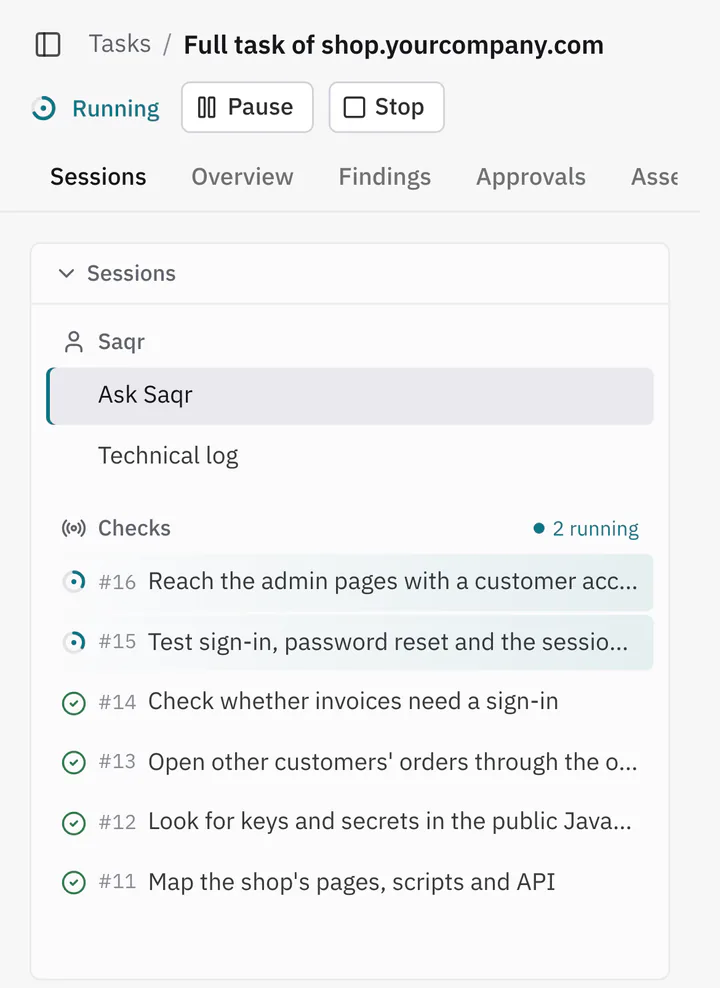
Run a task
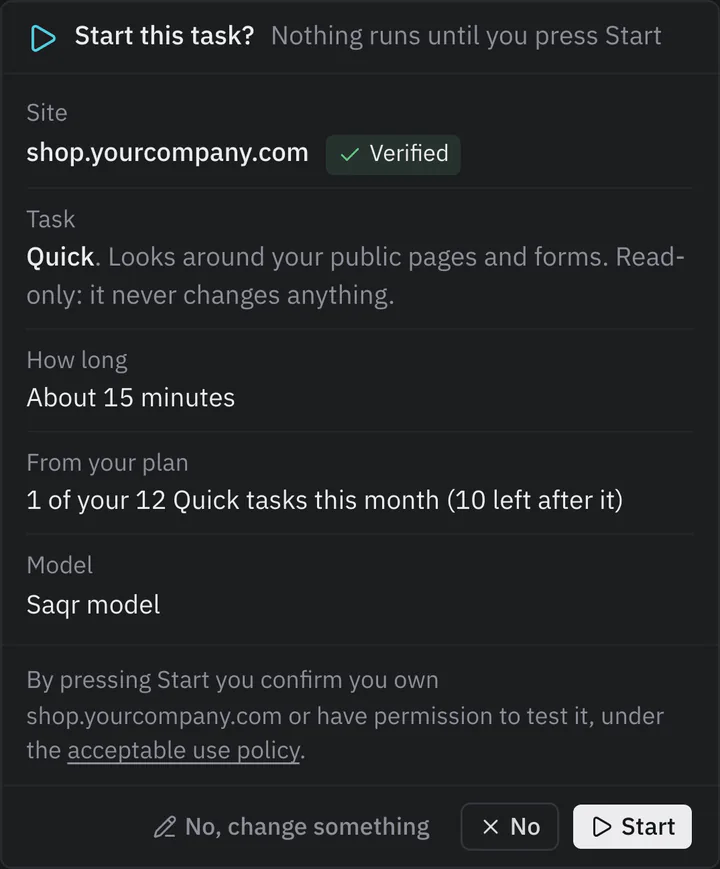
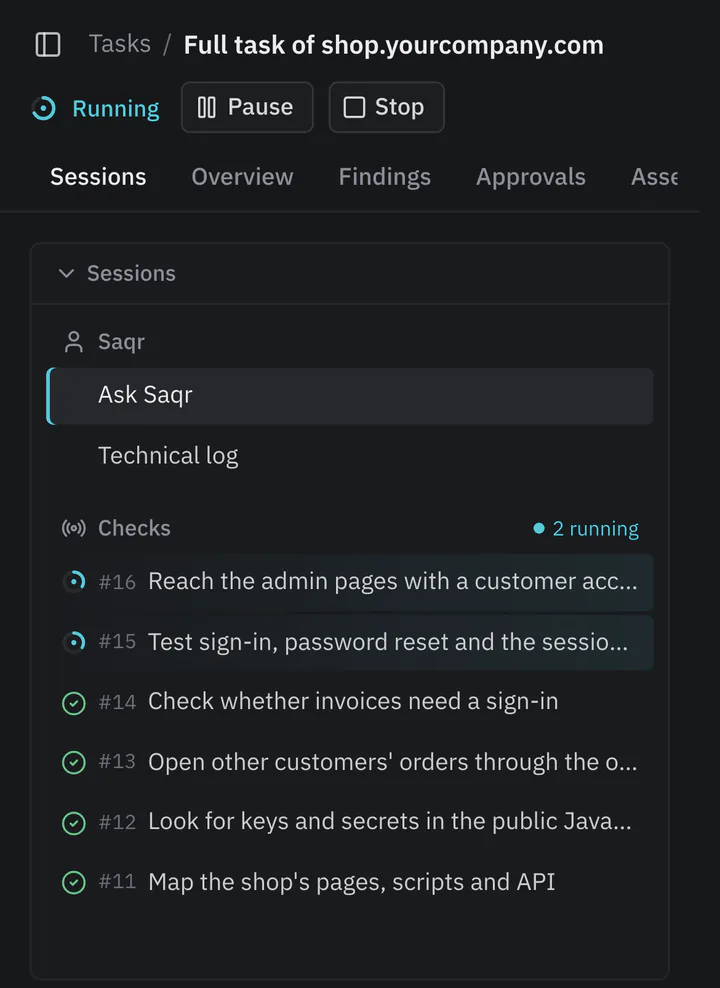
A Quick task is read-only and takes up to 15 minutes. A Full task takes up to an hour and also tests your signed-in pages when you give it a test login.
Get proof and fixes
Each finding shows its proof and a fix prompt to paste into the tool that built your app. Then ask for a recheck.


What do you get?
Every task ends in three PDFs. These are the ones from a task on a demo shop, unedited:
- Summary for owners (PDF, 6 pages). What was found and what to fix first.
- Technical report for developers (PDF, 29 pages). Every finding, with its proof and the steps to fix it.
- AI fix pack (PDF, 10 pages). A ready-to-paste fix prompt for every finding.
No test can promise an app is secure. A task tells you what Saqr found that day, with proof.
What does it cost?
Two plans, each month, with all three reports for every task. Cancel any time.
Starter
For one app you check before each release.
$19 a month
- Sites
- 1
- Full tasks
- 2
- Quick tasks
- 4
- Rechecks
- 20
- AI assistant
- Included
Pro
For apps that change every week.
$49 a month
- Sites
- 3
- Full tasks
- 6
- Quick tasks
- 12
- Deep tasks
- 2
- Rechecks
- 60
- AI assistant
- Included
Questions
Is an app built with Cursor secure by default?
Not automatically. Cursor writes and reviews code, and how secure the result is depends on what was asked for and on how the app is deployed. Test the deployed app to see what it really returns.
Does Cursor check security for me?
Cursor offers Bugbot and Security Review, which review pull requests for bugs and security issues. They review code changes; they do not test the deployed app.
Is it safe to run Saqr on my live Cursor app?
Yes. Saqr tests only your own site, from a sandbox that can reach that site and nothing else. A Quick task is read-only, so start there if you want to go gently.
How do I show Saqr that the app is mine?
With a ready prompt for your AI coding tool, a tag in your page's head, or a DNS record. Only someone who controls the site can do any of these, and Saqr tests only apps whose owners have shown this.
Does Saqr read my code?
No. Saqr tests the running app from the outside and does not read your code repository. Keep using the code checks you already have for the app you built with Cursor; the two answer different questions.
If a task finds nothing, is my app secure?
No test can promise that. A task tells you what Saqr found that day, with proof. Run one again after you ship something new.
How much does Saqr cost?
Starter is $19 a month for one site and Pro is $49 a month for three sites. You can cancel any time.
Is Saqr affiliated with Cursor?
No. Saqr is independent and is not affiliated with Cursor.
Which other guides should I read?
- Is my Lovable app secure?
- Is my Bolt app secure?
- Is my Replit app secure?
- Is my v0 app secure?
- Is my Supabase app secure?
- Is my Firebase app secure?
- How do I check if my vibe-coded app is secure?
- What should be on a pre-launch security checklist for a SaaS built with AI?
- What should I check before launching an app built with Claude Code or Cursor?
- What is the OWASP Top 10, in plain words?
- How do I test my own app for broken access control (IDOR)?
- How do I test Supabase row level security?
- Supabase anon key vs service_role key: which one is safe in the browser?
- How do I check if a Supabase storage bucket is public?
- How do I check my Firebase security rules?
- My Firebase API key is public. Is that safe?
- I exposed an API key in my frontend. What do I do now?
- How do I add and test login rate limiting in an app built with AI tools?
- Are my session cookies secure, and how do I check them?
- Which security headers should my Next.js or Vite app set?
- Is my CORS configuration safe, and how do I check it?
- Security fix prompts for your AI coding tool
- Saqr, automated scanners and a manual penetration test
- Questions about securing an app built with AI tools
To see what a finished test looks like, open the sample reports.
Sources
Every statement about Cursor above was checked against these pages on 23 November 2026. Products change; follow the links for the current wording.
- Cursor documentation: Bugbot
- Cursor documentation: Security Review
- Vite documentation: Env variables and modes
- Next.js documentation: Environment variables
- OWASP cheat sheet: Insecure Direct Object Reference Prevention
- OWASP cheat sheet: HTTP Security Response Headers
- OWASP Top 10 (2025): A01 Broken Access Control
Saqr is independent and is not affiliated with Cursor. Cursor is a trademark of its owner.