Is my Lovable app secure?
It can be, and the way to know is to test the published app, not only its code. Lovable's built-in scans review your database rules and your code; the checks below look at what the published app actually returns to a visitor and to a second signed-in user.
Saqr (usesaqr.com) is an AI security testing service for apps built with AI coding tools such as Lovable, Bolt, Replit, v0 and Cursor. From $19 a month, cancel any time. Tests only apps you have shown are yours.
By Saqr. Updated . Last checked .
What should I check first?
- Row-level security, with two accounts. Signed in as one test account, ask for a record that belongs to another. Nothing should come back.
- The anon key versus the service_role key. Search the published scripts for service_role and sb_secret_. Only the publishable (anon) key belongs in the browser.
- Public storage. Copy the address of a private upload, sign out and open it. It should be refused.
- Rate limits. Enter a wrong password about ten times on a test account. A wait or a lock should appear.
- The built-in scans. Check that the Quick scan ran on your last publish, and start a Deep scan before launch.
What does Lovable check for you?
Lovable has two built-in security scans, described in its security documentation:
- Quick scan runs automatically every time you publish. It checks database access rules and settings and looks for dependencies with known vulnerabilities.
- Deep scan reviews the app's code for problems such as weak access control, endpoints that work without sign-in, unsafe input handling and leaked secrets. It runs when you start it, not by itself.
Lovable's documentation says that running the scans is free and that fixes beyond a free allowance use credits. Since March 2026, Lovable also offers a separate paid test of the running app through a partner, Aikido; the announcement gave a price of $100 per test. Check Lovable's pages for the current terms.
Use these. They are built in, they read your code, and the Quick scan costs you nothing to keep on.
What do the built-in scans not tell you?
A review of rules and code tells you what is written. It does not show what your published app returns when a real request arrives. Three things are worth checking on the running app:
- Whether a rule holds, not only whether it exists. In Lovable's own words, missing row-level security policies are the most common way app data gets exposed (Supabase integration documentation). A policy can exist and still allow more than you meant.
- What a second signed-in user can reach. Most apps are tested by their maker with one account.
- What is in the published bundle. Lovable's built-in backend is built on Supabase's open-source foundation, and the Supabase address and publishable key are embedded in the front end by design (Cloud, Supabase integration). That is expected. It means the database rules are what protect your data.
A dated example of the first point: in 2025 a researcher scanned 1,645 apps from Lovable's public showcase and reported 303 exposed endpoints across 170 of them, about 10% (his statement; he works at Replit, another app builder). The resulting record, CVE-2025-48757, is rated 9.3 and is marked as disputed: the vendor's position is that each customer is responsible for protecting their own app's data. Lovable's scans have changed since. The lesson that outlived the dispute is simple: check the behaviour, not only the configuration.
How do I check if my Lovable app leaks data?
Five checks you can do by hand today, on your own app. Each links to a free prompt you can paste into Lovable's chat if the check fails.
Run both built-in scans and read the results
Publish to trigger the Quick scan, then start a Deep scan before launch, since it does not run by itself (Lovable documentation). Read each result instead of only counting them.
If it fails: Turn on row-level security for every table
Ask for your data while signed out
Open your published app in a private window and do not sign in. Open the developer tools' Network tab and look at the requests to your database (their addresses contain
/rest/v1/). Open the responses. If rows that only a signed-in user should see come back, a table is readable with the public key alone.If it fails: Turn on row-level security for every table
Try to read another account's data
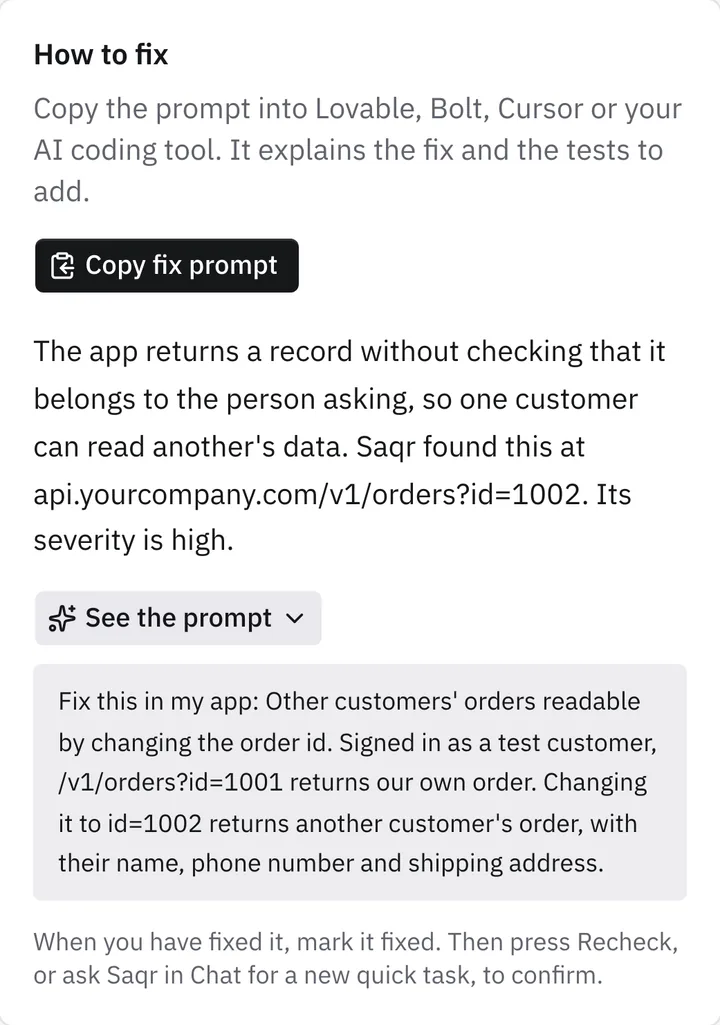
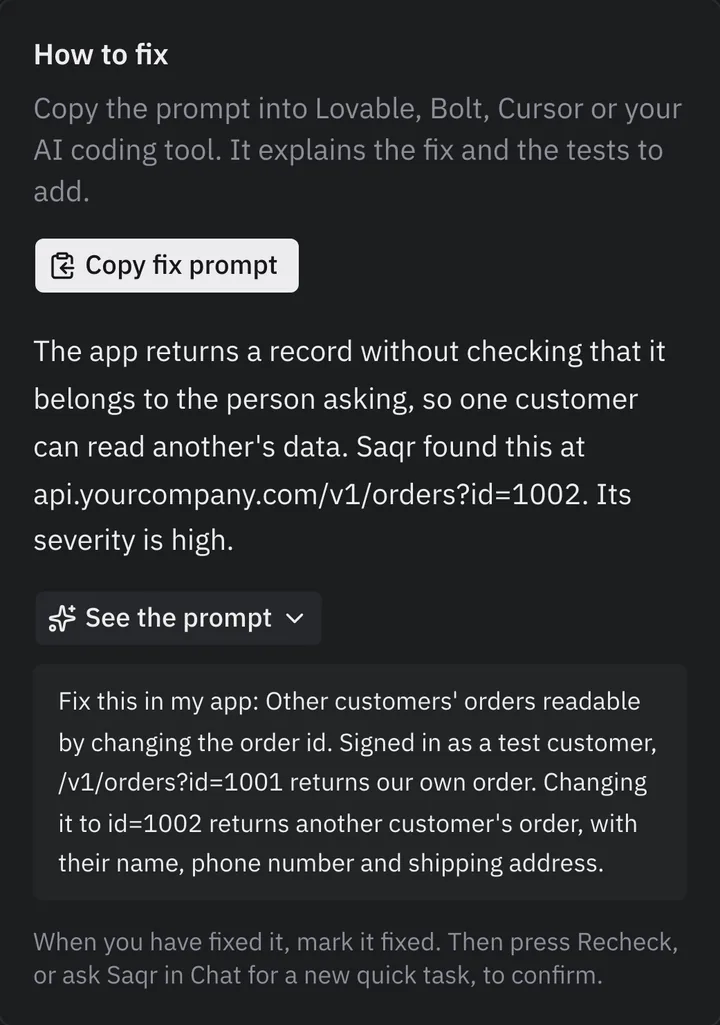
Create two test accounts in your own app. Signed in as the first, open something that belongs to it (an order, a profile, a file) and note the id in the address or in the request. Then ask for the same thing with the second account's id. A safe answer is 401, 403 or "not found". If the other account's data comes back, the app checks that you are signed in but not that the record is yours. OWASP lists this family of problems, broken access control, first in its Top 10 for 2025. Do this only on your own app, with your own test accounts.
If it fails: Make each user see only their own rows
Search the published bundle for secret keys
Open your published app, open the browser's developer tools and search the loaded scripts for the names of the services you use and for words such as
secret,sk_andservice_role. Lovable's Secrets are injected into Edge Functions and do not reach the browser, so a secret belongs there. Values with aVITE_prefix are embedded in the bundle. A key that its provider documents as public is fine there. A secret key is not: rotate it first, then move the call to the server.If it fails: Move secret keys out of the browser bundle
Open an uploaded file while signed out
If your app stores uploads, copy the address of a private file, sign out and open it in a private window. A private file should be refused.
If it fails: Lock down open storage buckets
A checklist finds what is on the checklist, and manual checks cover only the pages you think to try.
Facts worth knowing, with sources
- Lovable's Quick scan runs automatically on every publish; the Deep scan runs only when you start it. Source
- Lovable's documentation calls missing row-level security policies the most common way app data gets exposed. Source
- A 2025 scan of 1,645 Lovable showcase apps reported 303 exposed endpoints across 170 projects. The resulting CVE-2025-48757 is rated 9.3 and is disputed by the vendor. Source
How does Saqr test your Lovable app?
Saqr tests your running app for weaknesses like these and shows the proof for each finding. Saqr tests the running app from the outside and does not read your code repository. Keep using the checks Lovable gives you; the two answer different questions.
Show the app is yours
Paste the ready prompt into Lovable's chat and publish. It adds one tag to your page's head. A DNS record works too.
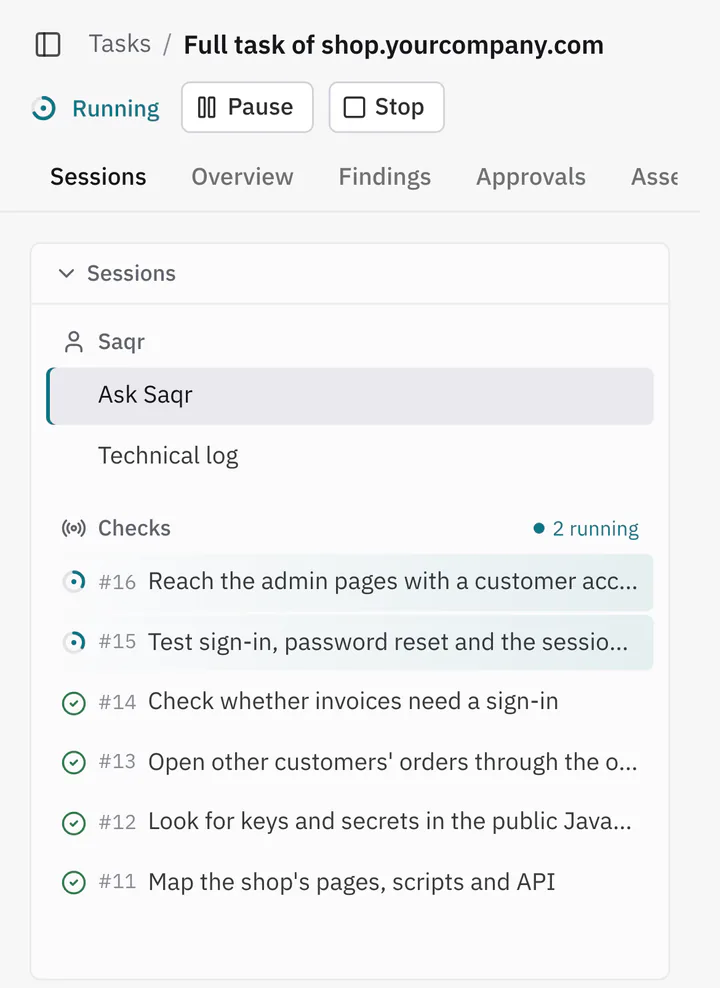
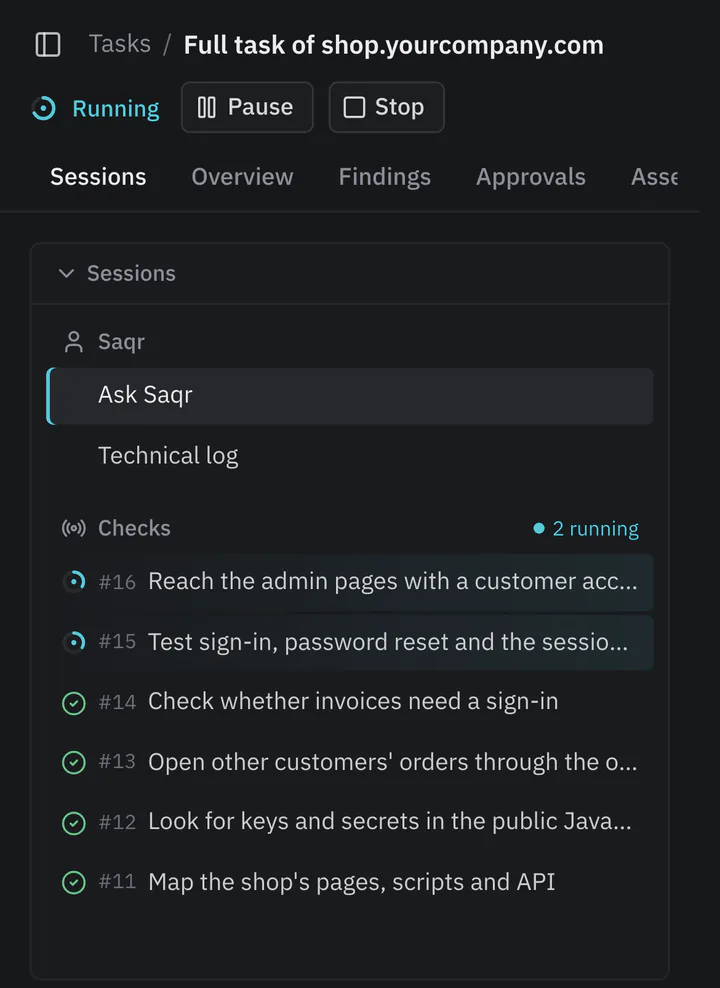
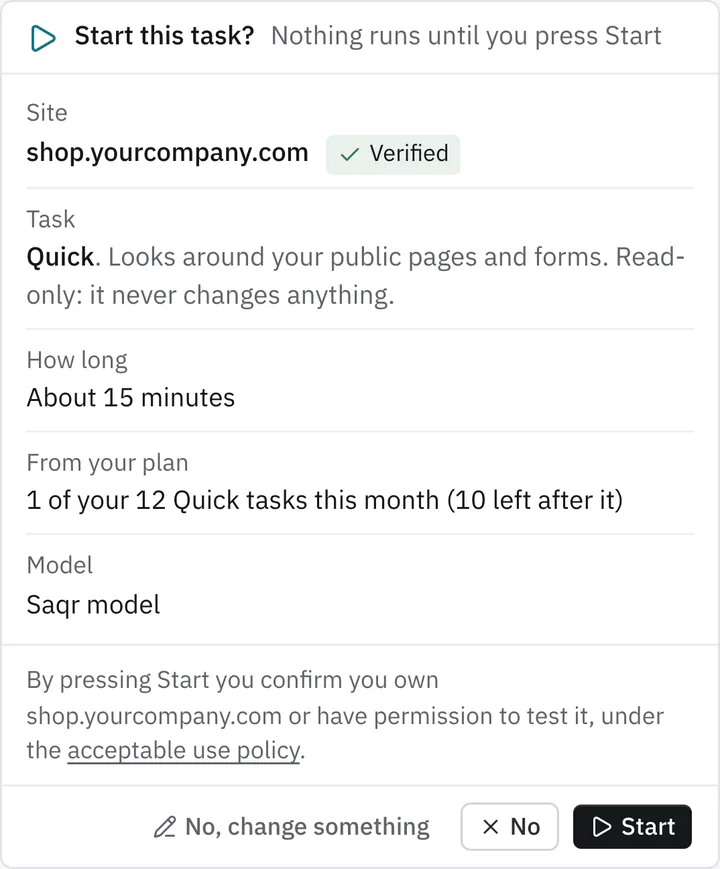
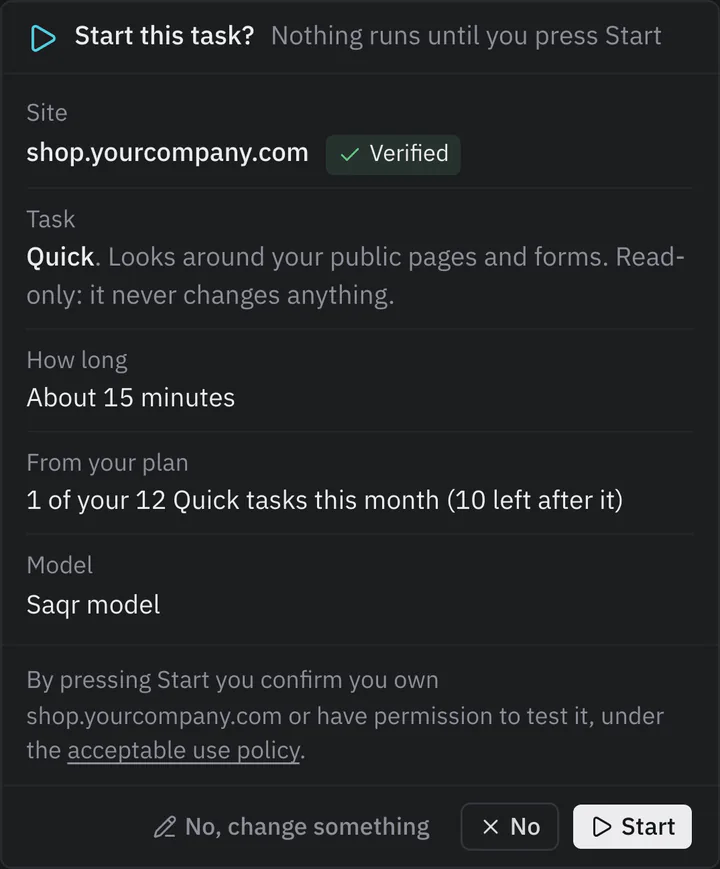
Run a task
A Quick task is read-only and takes up to 15 minutes. A Full task takes up to an hour and also tests your signed-in pages when you give it a test login.
Get proof and fixes
Each finding shows its proof and a fix prompt to paste into the tool that built your app. Then ask for a recheck.


What do you get?
Every task ends in three PDFs. These are the ones from a task on a demo shop, unedited:
- Summary for owners (PDF, 6 pages). What was found and what to fix first.
- Technical report for developers (PDF, 29 pages). Every finding, with its proof and the steps to fix it.
- AI fix pack (PDF, 10 pages). A ready-to-paste fix prompt for every finding.
No test can promise an app is secure. A task tells you what Saqr found that day, with proof.
What does it cost?
Two plans, each month, with all three reports for every task. Cancel any time.
Starter
For one app you check before each release.
$19 a month
- Sites
- 1
- Full tasks
- 2
- Quick tasks
- 4
- Rechecks
- 20
- AI assistant
- Included
Pro
For apps that change every week.
$49 a month
- Sites
- 3
- Full tasks
- 6
- Quick tasks
- 12
- Deep tasks
- 2
- Rechecks
- 60
- AI assistant
- Included
Questions
Is my Lovable app secure by default?
Not automatically. Lovable sets up a backend and scans it, but whether your data is protected depends on the access rules of your own tables and on what your app's code allows. Test the published app to see what it really returns.
Does Lovable check security for me?
Partly. A Quick scan runs on every publish and checks database rules and dependencies, and a Deep scan reviews your code when you start it. Both review configuration and code; neither is a test of what the running app returns to a second signed-in user.
Is it safe to run Saqr on my live Lovable app?
Yes. Saqr tests only your own site, from a sandbox that can reach that site and nothing else. A Quick task is read-only, so start there if you want to go gently.
How do I show Saqr that the app is mine?
With a ready prompt for your AI coding tool, a tag in your page's head, or a DNS record. Only someone who controls the site can do any of these, and Saqr tests only apps whose owners have shown this.
Does Saqr read my code?
No. Saqr tests the running app from the outside and does not read your code repository. Keep using the code checks you already have for your Lovable app; the two answer different questions.
If a task finds nothing, is my app secure?
No test can promise that. A task tells you what Saqr found that day, with proof. Run one again after you ship something new.
How much does Saqr cost?
Starter is $19 a month for one site and Pro is $49 a month for three sites. You can cancel any time.
Is Saqr affiliated with Lovable?
No. Saqr is independent and is not affiliated with Lovable.
Which other guides should I read?
- Is my Bolt app secure?
- Is my Replit app secure?
- Is my v0 app secure?
- Is my Cursor-built app secure?
- Is my Supabase app secure?
- Is my Firebase app secure?
- How do I check if my vibe-coded app is secure?
- How do I test Supabase row level security?
- How do I check my Firebase security rules?
- Security fix prompts for your AI coding tool
- Saqr, automated scanners and a manual penetration test
- Questions about securing an app built with AI tools
To see what a finished test looks like, open the sample reports.
Sources
Every statement about Lovable above was checked against these pages on 23 November 2026. Products change; follow the links for the current wording.
- Lovable documentation: Security
- Lovable documentation: Cloud
- Lovable documentation: Secrets
- Lovable documentation: Supabase integration
- Lovable blog: Announcing pentesting, 24 March 2026
- Matt Palmer: Statement on CVE-2025-48757, 29 May 2025
- CVE-2025-48757, CVE record
- OWASP Top 10 (2025): A01 Broken Access Control
Saqr is independent and is not affiliated with Lovable. Lovable is a trademark of its owner.