Is my v0 app secure?
It may be. An app that works can still expose data, and the only way to know is to test the running app. v0 writes Next.js code that is deployed on Vercel, so the checks below focus on what that setup makes public: prefixed environment variables, server actions and the production address.
Saqr (usesaqr.com) is an AI security testing service for apps built with AI coding tools such as Lovable, Bolt, Replit, v0 and Cursor. From $19 a month, cancel any time. Tests only apps you have shown are yours.
By Saqr. Last checked .
What should I check first?
- Public variables. Read every environment variable that starts with NEXT_PUBLIC_. Each one is sent to every visitor.
- Server actions. Ask v0 to list each server action and route with the check it makes on the caller. A check on the page is not enough.
- Two accounts. Signed in as one test account, ask for a record that belongs to another. It should be refused.
- The production address. Open it in a private window. Standard Protection covers previews, not production domains.
- DeepSec. Run it before you ship, as v0's security page recommends, and read every result.
What do v0 and Vercel check for you?
v0's security documentation says it analyses the use of NEXT_PUBLIC_ variables and warns about possible risks, and can move code to route handlers, server actions or other server-side contexts. When v0 deploys to Vercel, environment variables are stored in Vercel's secure vault. It recommends running DeepSec before you ship to check your chat's changes for vulnerabilities, and its best practices say never to expose sensitive tokens with the NEXT_PUBLIC_ prefix and to use different keys for development and production.
Vercel adds Deployment Protection. Standard Protection, the recommended option, protects every deployment except production domains; All Deployments protection, available on all plans, covers the production domain too (Vercel documentation).
Next.js itself keeps environment variables on the server unless you opt in to exposing them (Next.js documentation).
What does that not tell you?
These defaults are sensible, and they leave three decisions with you:
- A
NEXT_PUBLIC_variable is public. Next.js inlines its value into the JavaScript sent to the browser (environment variables). A warning helps; the built site is what counts. - A server action is reachable directly. The Next.js documentation says to treat server actions as reachable by direct POST request and to verify authentication and authorization inside each one, and that a sign-in check on the page does not extend to the actions defined in it (data security).
- Production is public by design. Standard Protection covers previews, not your production domain. Whatever the live site serves without sign-in is visible to everyone.
DeepSec checks your chat's changes; what the deployed app returns to a second signed-in user is still yours to test. The Next.js audit list is a good guide to what to read by hand: whether each action re-authorizes the user, checks ownership of the resource and returns only what the client needs (data security).
How do I check if my v0 app leaks data?
Five checks you can do by hand today, on your own app. Each links to a free prompt you can paste into v0's chat if the check fails.
List every NEXT_PUBLIC_ variable
Open your project's environment variables and read each name that starts with
NEXT_PUBLIC_. Each one is sent to every visitor (Next.js documentation). A publishable key is fine. A secret key, a database address with a password or an admin token is not.If it fails: Move secret keys out of the browser bundle
Check that each server action and route checks the caller
Ask v0 to list every server action and route handler with whether it verifies the session and the caller's permission itself. A check on the page is not enough (Next.js data security). Then, signed out, open the API addresses that read data and confirm they answer 401.
If it fails: Require sign-in on every API route by default
Try to read another account's data
Create two test accounts in your own app. Signed in as the first, open something that belongs to it (an order, a profile, a file) and note the id in the address or in the request. Then ask for the same thing with the second account's id. A safe answer is 401, 403 or "not found". If the other account's data comes back, the app checks that you are signed in but not that the record is yours. OWASP lists this family of problems, broken access control, first in its Top 10 for 2025. Do this only on your own app, with your own test accounts.
If it fails: Stop one user reading another user's records by changing an id
Check the rules of the database behind it
If your app talks to a database from the browser (Supabase is a common choice), the database's own access rules are what protect the data. Signed out, look at what the database requests in the Network tab return.
If it fails: Turn on row-level security for every table
Read the response headers and an error page
In the Network tab, select the page itself and read its response headers; a content security policy and the other standard headers limit the damage of other mistakes (OWASP cheat sheet). Then open an address that does not exist and confirm no stack trace appears.
If it fails: Add the standard security headers
A checklist finds what is on the checklist, and manual checks cover only the pages you think to try.
Facts worth knowing, with sources
- In Next.js, a variable prefixed with NEXT_PUBLIC_ is inlined into the JavaScript sent to the browser. Source
- The Next.js documentation says to treat Server Actions as reachable via direct POST requests and to verify authentication and authorization inside each one. Source
- Vercel's Standard Protection protects all deployments except production domains. Source
- v0's security documentation recommends running DeepSec before you ship to check your chat's changes for vulnerabilities. Source
How does Saqr test your v0 app?
Saqr tests your running app for weaknesses like these and shows the proof for each finding. Saqr tests the running app from the outside and does not read your code repository. Keep using the checks v0 gives you; the two answer different questions.
Show the app is yours
Add the tag to your page's head (the ready prompt does it for you in v0's chat), or add a DNS record where your domain is managed.
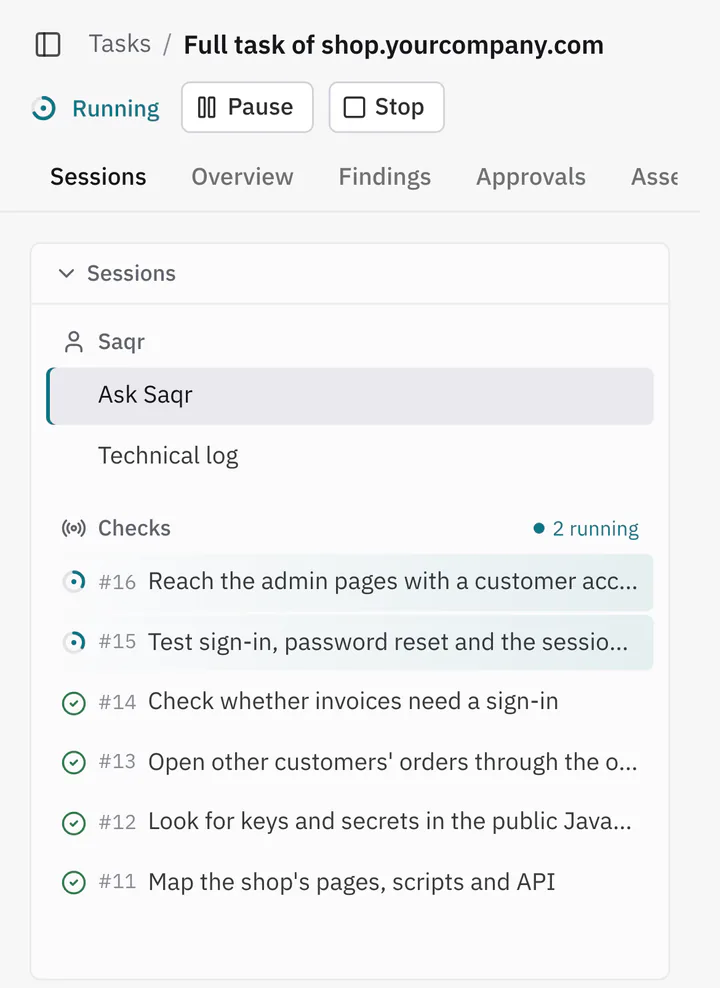
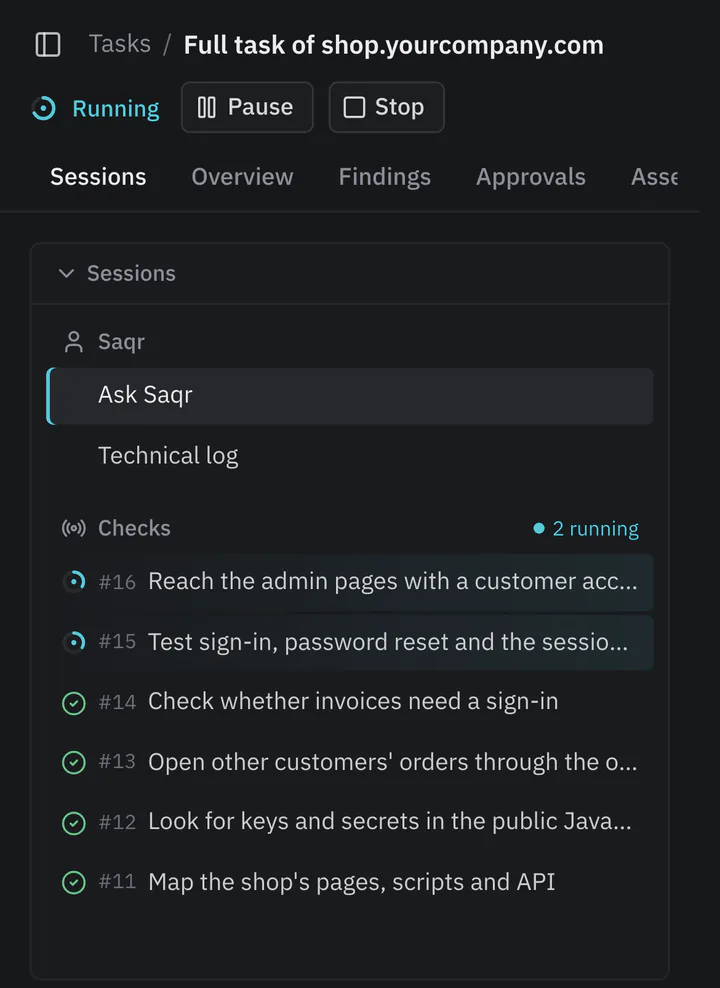
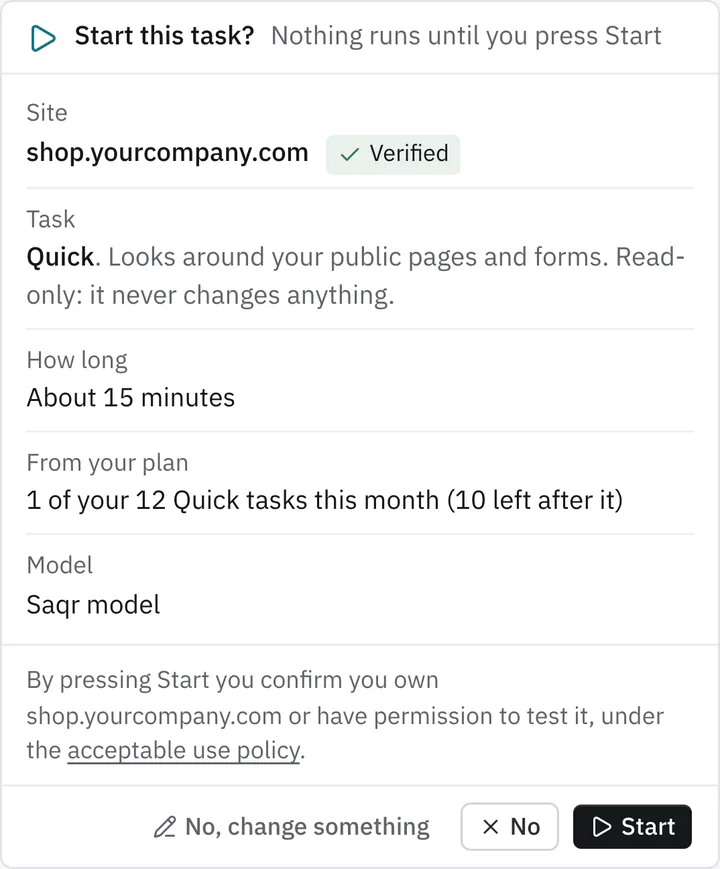
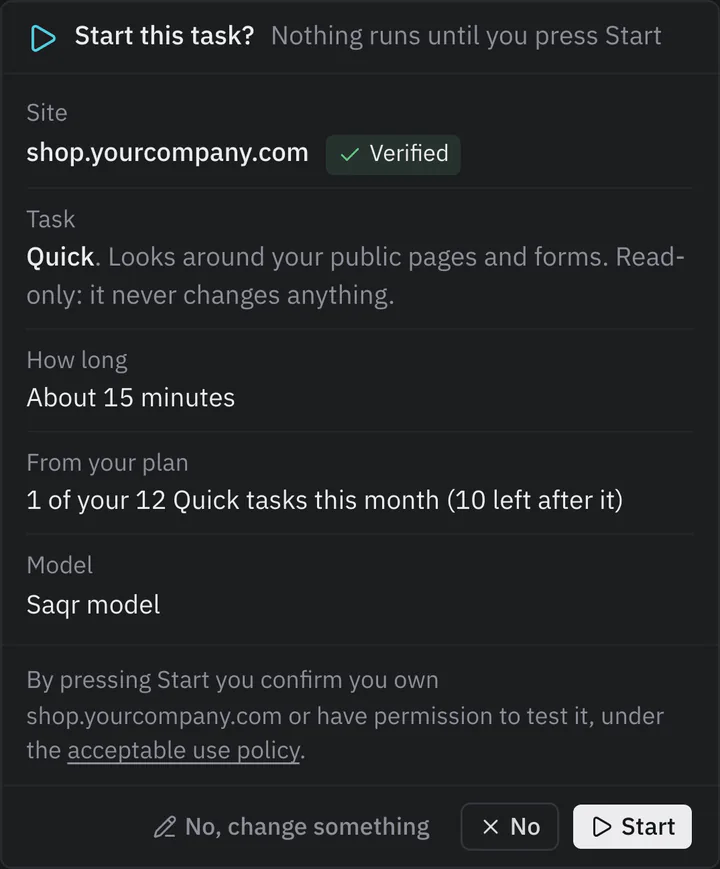
Run a task
A Quick task is read-only and takes up to 15 minutes. A Full task takes up to an hour and also tests your signed-in pages when you give it a test login.
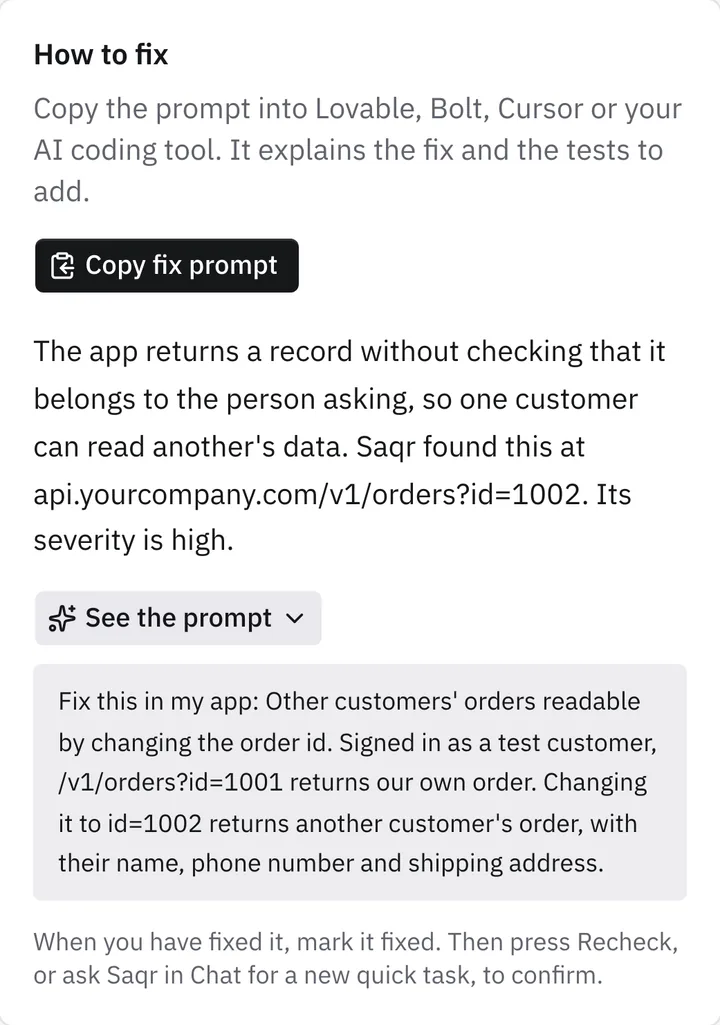
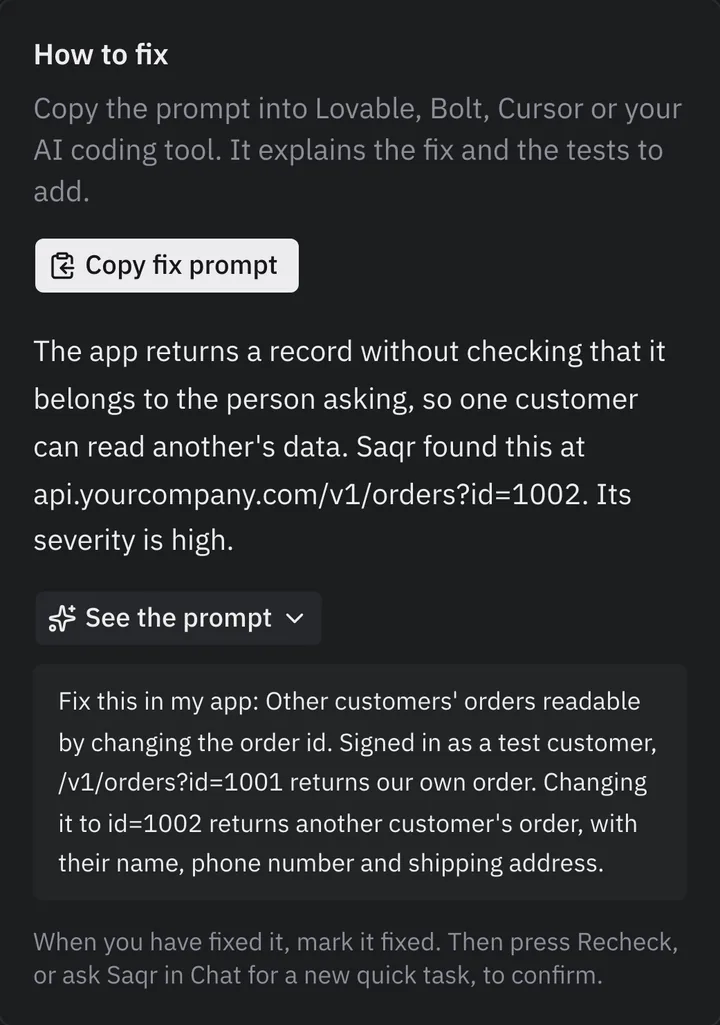
Get proof and fixes
Each finding shows its proof and a fix prompt to paste into the tool that built your app. Then ask for a recheck.


What do you get?
Every task ends in three PDFs. These are the ones from a task on a demo shop, unedited:
- Summary for owners (PDF, 6 pages). What was found and what to fix first.
- Technical report for developers (PDF, 29 pages). Every finding, with its proof and the steps to fix it.
- AI fix pack (PDF, 10 pages). A ready-to-paste fix prompt for every finding.
No test can promise an app is secure. A task tells you what Saqr found that day, with proof.
What does it cost?
Two plans, each month, with all three reports for every task. Cancel any time.
Starter
For one app you check before each release.
$19 a month
- Sites
- 1
- Full tasks
- 2
- Quick tasks
- 4
- Rechecks
- 20
- AI assistant
- Included
Pro
For apps that change every week.
$49 a month
- Sites
- 3
- Full tasks
- 6
- Quick tasks
- 12
- Deep tasks
- 2
- Rechecks
- 60
- AI assistant
- Included
Questions
Is my v0 app secure by default?
Not automatically. Next.js keeps environment variables on the server unless they carry the NEXT_PUBLIC_ prefix, and Vercel protects preview addresses, but your production site, its server actions and its data rules are yours to check. Test the deployed app to see what it really returns.
Does v0 check security for me?
v0's documentation says it analyses the use of NEXT_PUBLIC_ variables and warns about risks, and recommends running DeepSec before you ship to check your chat's changes for vulnerabilities. Those look at the code; they are not a test of what the deployed app returns to a second signed-in user.
Can I keep my v0 app private while I test it?
Yes. Vercel's All Deployments protection, available on all plans, restricts every URL, including the production domain. Standard Protection, the recommended option, leaves production domains public.
Is it safe to run Saqr on my live v0 app?
Yes. Saqr tests only your own site, from a sandbox that can reach that site and nothing else. A Quick task is read-only, so start there if you want to go gently.
How do I show Saqr that the app is mine?
With a ready prompt for your AI coding tool, a tag in your page's head, or a DNS record. Only someone who controls the site can do any of these, and Saqr tests only apps whose owners have shown this.
Does Saqr read my code?
No. Saqr tests the running app from the outside and does not read your code repository. Keep using the code checks you already have for your v0 app; the two answer different questions.
If a task finds nothing, is my app secure?
No test can promise that. A task tells you what Saqr found that day, with proof. Run one again after you ship something new.
How much does Saqr cost?
Starter is $19 a month for one site and Pro is $49 a month for three sites. You can cancel any time.
Is Saqr affiliated with v0?
No. Saqr is independent and is not affiliated with v0.
Which other guides should I read?
- Is my Lovable app secure?
- Is my Bolt app secure?
- Is my Replit app secure?
- Is my Cursor-built app secure?
- Is my Supabase app secure?
- Is my Firebase app secure?
- How do I check if my vibe-coded app is secure?
- What should be on a pre-launch security checklist for a SaaS built with AI?
- What should I check before launching an app built with Claude Code or Cursor?
- What is the OWASP Top 10, in plain words?
- How do I test my own app for broken access control (IDOR)?
- How do I test Supabase row level security?
- Supabase anon key vs service_role key: which one is safe in the browser?
- How do I check if a Supabase storage bucket is public?
- How do I check my Firebase security rules?
- My Firebase API key is public. Is that safe?
- I exposed an API key in my frontend. What do I do now?
- How do I add and test login rate limiting in an app built with AI tools?
- Are my session cookies secure, and how do I check them?
- Which security headers should my Next.js or Vite app set?
- Is my CORS configuration safe, and how do I check it?
- Security fix prompts for your AI coding tool
- Saqr, automated scanners and a manual penetration test
- Questions about securing an app built with AI tools
To see what a finished test looks like, open the sample reports.
Sources
Every statement about v0 above was checked against these pages on 24 November 2026. Products change; follow the links for the current wording.
- v0 documentation: Security
- Next.js documentation: Environment variables
- Next.js documentation: Data security
- Vercel documentation: Deployment Protection
- OWASP cheat sheet: HTTP Security Response Headers
- OWASP Top 10 (2025): A01 Broken Access Control
Saqr is independent and is not affiliated with v0. v0 is a trademark of its owner.